In East Asian medicine, the element of Wood [木; mù] expresses itself in two organ networks within the body.
The Liver correlates with the yin of Wood. It holds the blood, governs the smooth movement of qi through the whole system, and houses the hun [魂]—the ethereal soul whose domain is vision, dreaming, and long-range planning.
The Gallbladder [胆囊; dǎnnáng] correlates with the yang expression of Wood.
Where the Liver conceives the plan, the Gallbladder enacts it. Where the Liver envisions the form a life might take, the Gallbladder is the first step, the embodied decision, the actions that create the new direction.
In classical texts, the Gallbladder is the Official of Uprightness and Decision. The Neijing states: "The Gallbladder is the upright official; determination and decisions come from here." This relationship becomes especially alive in spring, when the element of Wood predominates and the body is called out of winter's stillness into forward movement—when the sap begins to move, the light returns, and the whole organism wants to rise.
In this article, I'll explore the Gallbladder [胆; dǎn] in East Asian medicine—its pathway along the lateral body, from the temples to the fourth toes—and how its nature shapes our capacity for courageous action, the suppleness of our connective tissue, our ability to metabolize experience, regulate hormone health, and influence our relationship to timing, rhythm, and the willingness to begin again.
[*In keeping with academic convention in Classical Chinese medicine, throughout this article I use capital letters for certain words when referencing meanings that are best expressed through the original ancient pictographic Chinese characters. Capitalized terms reflect a broader word-field of meaning that includes symbolic cosmology, as well as mental, emotional, spiritual, and physiologic dimensions. For example, Gallbladder refers to the Chinese medicine organ network, its meridian, and energetic qualities, while gallbladder refers to the Western anatomical organ.]
The Character of the Gallbladder: Stepping Forward
The Chinese character for Gallbladder, dǎn [胆], contains the radical dan [旦]—a picture of the sun rising above the horizon. The character is also used in Chinese to mean courage, the quality of daring audacity we recognize in the brilliance of dawn: the yang rising out of the darkness.
Classical imagery within the Gallbladder's word-field deepens this picture. One image shows someone standing at the edge of a cliff. To step forward is both an act of letting go and an act of commitment—you cannot half-step off a cliff. There is also the image of a great foot and the number one: the first step of a long march in a new direction, the steadfast determination required to initiate it. Another image suggests the cutting of silk or rope—the Gallbladder's capacity to sever itself cleanly from what is stagnant, to break from old patterns so that life can begin again on fresh terms.
"All the movements of the whole year take their cue from the Gallbladder," one ancient text notes. This is why New Year's resolutions tend to arise in Gallbladder time—they require exactly this quality: an inner resolve that rises up to let go of old experience, cut through hesitation, and step forward into what's next.
According the Chinese medicine Organ Clock, which splits the day into twelve two-hour segments, Gallbladder time belongs at midnight, directly opposite the Heart at noon. The Heart marks the turning point of the day, when maximum yang tips toward yin. The Gallbladder marks the turning point of the night, when maximum yin tips back toward yang. Together, they function as the twin pivot points around which the daily cycle of yin and yang revolves—one offering communion and receptivity, the other offering resolve and direction.
The Pathway of the Gallbladder Meridian
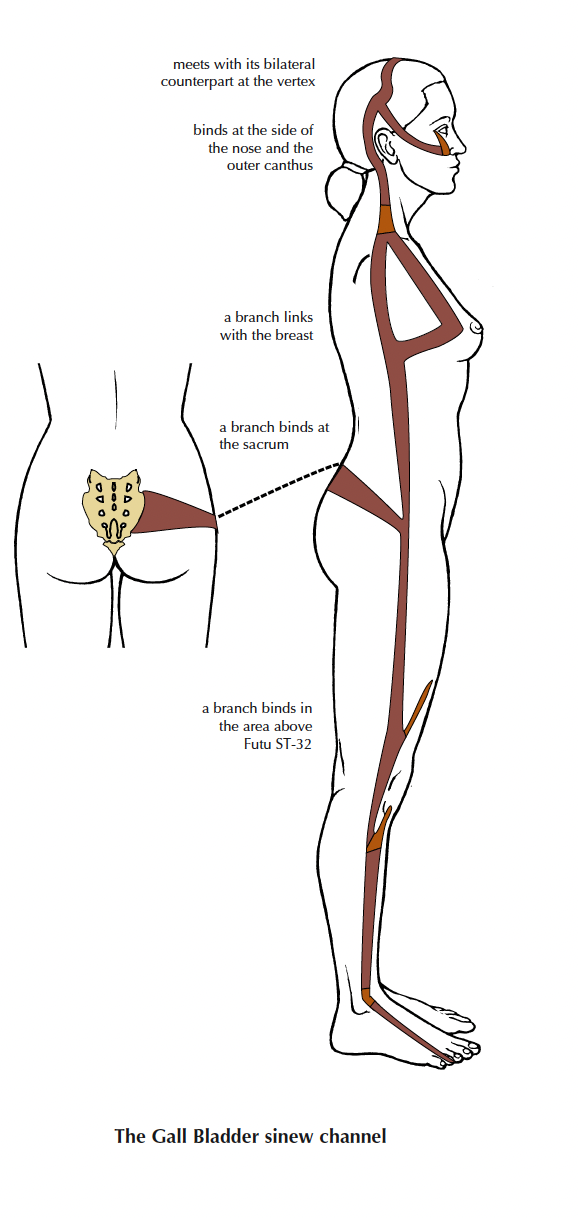
The Gallbladder channel is the great lateral channel of the body. With 44 primary points plus numerous intersections, its pathway is one of the most architecturally complex of the meridians on the body—and among the most clinically significant for anyone who carries tension on the sides of their body, head, shoulders, or hips.
The channel begins at the outer canthus of the eye at Tongziliao GB-1. From here, it does something no other meridian does: it zigzags. The channel criss-crosses the side of the skull in four distinct arcs—winding forward, backward, and over—before descending behind the ear, crossing the shoulder to one of the strongest, most intense points on the body at Jianjing GB-21.
The main channel descends from the shoulder into the axilla, passes along the lateral ribcage and side body influencing suppleness and rigidity of the torso and pelvis.
It descends along the lateral aspects of the hips, then runs the entire lateral aspect of the thigh and knee, continues down the lateral aspect of the lower leg, crosses the anterior lateral malleolus, traverses the dorsum of the foot along the fourth metatarsal, and ends at the lateral tip of the fourth toe.
This full lateral line—from skull to little toe—makes the Gallbladder channel the architect of the side body.
Clinically, the Gallbladder sinew channel governs the connective tissue along this entire lateral seam. When it is involved in a pattern, you may notice:
temporal headaches or one-sided migraines along the channel's path through the skull
TMJ tension, jaw clenching, or ear fullness
changes in vertigo, balance, or tinnitus
tightness at the base of the occiput, often paired with restricted neck rotation
shoulder blade tension or scapular fixation
guardin tightness and restrictions in the lateral ribcage, often felt as a constricted inhale or irritability around a bra-line
lateral lumbar pain
lateral hip aching (piriformis syndrome or sciatica)
iliotibial band tightness, lateral knee pain, or ilio-tibial tracking disorder
lateral ankle instability or chronic stiffness and tightness across the ankle or dorsum of the foot.
These are not isolated musculoskeletal complaints. They are expressions of a deeper pattern—the Gallbladder sinew channel in a state of excess holding or chronic depletion, and with it, a body that cannot make smooth transitions, cannot bend without bracing, cannot move through life's turns with suppleness.
Bile, Fat, and the Chemistry of Detoxification
On a physiological level, the Gallbladder's classical Chinese medicine functions align strikingly with what we understand biochemically. The gallbladder concentrates and releases bile—the golden yellow fluid produced by the liver and stored until it's stimulated to emulsify dietary fats in the small intestine.
This function is far more consequential than it sounds. Without adequate bile flow, fat-soluble nutrients—vitamins A, D, E, and K—cannot be absorbed. Hormones, which are largely fat-derived, cannot be properly synthesized, detoxified, or cleared. The liver's detoxification pathways, which depend on conjugating and excreting waste compounds through bile, become sluggish. Dietary fats sit in the duodenum longer, fermenting rather than metabolizing, creating the bloating, nausea, bouts of ‘gut dumping’ (urgent diarrhea) or right-side heaviness that so often follows a fatty meal in a patient with compromised function.
From a Chinese medical perspective, the Gallbladder is said to store and secrete a clear, luminous elixir—a pure fluid, unlike the turbid substances of other hollow organs. Taoist alchemists considered bile the root of terrestrial life: the body's capacity to digest not just food but experience itself.
This metabolic interpretation extends into hormonal health. Estrogen, cortisol, and other lipid-derived hormones require liver conjugation and biliary excretion to leave the body. When bile flow is thick, sluggish, or insufficient—a condition often described in Chinese medicine as Gallbladder Damp-Heat, Gallbladder insuffiency, or Gallbladder qi stagnation—hormones recirculate. They re-enter the bloodstream through the gut rather than being excreted. This is one pathway through which Wood stagnation contributes to estrogen dominance, PMS, or the perimenopausal pattern of excess alongside deficiency.
In clinical practice, the Gallbladder's "bile" function also maps onto the body's capacity to process what comes in from the outside world—food, yes, but also impressions, experiences, relationships, and demands on our time and energy. The Gallbladder decides what to take in and what to let pass through. When this discernment is compromised, we absorb too much without metabolizing it—a kind of metaphysical indigestion that the body eventually expresses as physical stagnation.
The Dai Mai and the Hormonal Belt
The Gallbladder channel has a particularly intimate relationship with the Dai Mai [带脉]—the Belt Vessel, the only extraordinary meridian that runs horizontally rather than longitudinally through the body. The Dai Mai encircles the waist like a belt, binding all the vertical channels together at the level of the lower abdomen and pelvis. Three of its four acupuncture points belong to the Gallbladder channel, and its master opening point is Zulinqi GB-41, located on the dorsum of the foot.
When the Belt Vessel is tonified, supple, and open, qi and blood flow freely between the torso and the pelvis. When it is constricted—from stagnation, cold, damp accumulation, or the chronically held lateral tension described above—circulation to the pelvis, uterus, ovaries, and lower abdomen is impeded. In Chinese medicine, this manifests as a feeling of heaviness, fullness, or dragging at the waist; a kind of constricted pattern that keeps the lower-body feel stuck and holding.
Clinically, this connection has direct relevance to hormonal health. The Dai Mai governs the lower jiao and has a particular affinity with the gynecological organs. When Gallbladder qi stagnation extends into Belt Vessel restriction, the downstream effects can include irregular or painful menstruation, pelvic congestion, difficulty with ovulation, and the accumulation of damp-heat in the lower abdomen that Chinese medicine associates with conditions like PCOS and endometriosis. The meridians map clearly onto the hormonal recirculation problem discussed in the bile section: impaired biliary clearance plus impaired pelvic circulation plus chronic Wood stagnation creates a system in which estrogen and its metabolites cannot move efficiently out of the body.
Zulinqi GB-41 as the master point of the Dai Mai is one of the most important points in the system for addressing this constellation. Needling it—particularly in combination with the coupled extraordinary vessel point Waiguan SJ-5—opens the belt, releases pelvic restriction, and allows the vertical channels to communicate again. Patients often describe the sensation during treatment as a release of held breath they didn't know they were holding (“like little faucets are running but from the inside, circulating good energy”), precisely because the constriction at the waist had habitual and longstanding.
The Dai Mai also carries an important emotional dimension. In her book Kigo, Lori Dechar writes that the belt channel can become a kind of archive—a place where the body stores what it could not yet metabolize, what it needed to bind and contain until conditions were safe enough to release. The Gallbladder's function of cutting away from what is finished, of stepping forward and beginning again, depends on the Belt Vessel being permeable enough to allow that release. When the belt is rigid and the Gallbladder cannot dredge, the past accumulates at the waistline.
Shaoyang: The Hinge Between Seasons
The Gallbladder's constitutional nature is shaoyang [少阳]—lesser yang—which it shares with the Triple Warmer. Shaoyang occupies a unique position in six-channel theory: it is neither fully exterior nor fully interior, neither fully yin nor fully yang. Instead, it mediates between the inner and outer worlds.
This hinge quality expresses in the Gallbladder's clinical presentations. A shaoyang pattern classically produces alternating symptoms—alternating chills and fever, symptoms that shift sides, conditions that feel unresolved and cycling. Migraine headaches that shift. Ear symptoms that come and go. A person who feels fine, then suddenly doesn't. The Gallbladder in disharmony struggles to find and hold the middle ground.
This is also why the Gallbladder is particularly implicated in seasonal transitions—the body's ability to shift between registers, between activity and rest, between inner and outer focus. The Wood element governs spring, the season of transition par excellence: emergence from winter's yin gathering into the yang expansion of longer days and warming temperatures. If the Gallbladder’s function is stuck, or weighed down, the body cannot make that seasonal transition gracefully.
Gallbladder and Nervous System Hypervigilance
In the Tao of Trauma, the Wood Element and the Gallbladder in particular are understood as mirroring the sympathetic nervous system—the mobilization network that allows us to mount a response to a challenge and then return to rest. A healthy Wood Element rises to meet what needs to be met, then falls like a wave back to the zone of resiliency. The archetypal image of health Gallbladder function would be akin to an adept Taoist master: at peace, non-reactive, and relaxed when the external setting is peaceful, but able to leap into action with the utmost confidence and responsiveness if engaged by a threat. Then able to quickly regain composure, suppleness, calm, and serenity as soon as the inciting threat it resolved. (Compare this to the average person’s chronic hypervigilance to things like emails and cell phone notifications.)
When Gallbladder function is chronically dysregulated, this natural wave of calm-responsiveness-action-rest doesn’t completely resolve: instead and all to often, the person stays in the mobilization—over-engaged, over-responding, chronically irritated, angry, or in low levels of fear, all the while burning through their reserves rather than channeling them.
Anger as Information, Anger as Stagnation
Wood's emotion is anger, and the Gallbladder is its yang expression. This is worth saying clearly: anger is a healthy, physiologically appropriate response to obstruction, injustice, threat to self or others, or violation of one's boundaries. In health, Wood anger is directional—it arises, it names something true, it generates the force needed to move or change what needs moving, and then it resolves. The system returns to ease. The wave completes.
The problem is rarely the anger itself. The problem is what happens when anger cannot complete its arc.
Contemporary culture, including many of the institutional systems or relational patterns we grow up within, does not teach people how to allow anger to move through the body and discharge cleanly. Instead, anger is split: performed as reactivity (explosion, blame, chronic irritability) or suppressed entirely (accommodated, swallowed, converted into compliance). Neither of these is the healthy Gallbladder expression. Both are stagnation—one visible, one invisible, both costly.
In Chinese medicine, unexpressed or chronically suppressed anger is one of the primary causes of Liver qi stagnation. The Liver, recall, governs the smooth movement of qi through the whole system. When anger—which is directional energy that wants to move—has nowhere to go, it doesn't disappear. It accumulates. It thickens. It generates what the Classical texts call depressed or constrained Wood qi, which eventually produces heat as the pressure builds. This heat rises through the Gallbladder channel—the path of least resistance for constrained Wood—and manifests physically as one-sided headaches, jaw tension/grinding, shoulders like iron, tinnitus, eye strain, neck rigidity, and the lateral hip holding that is so characteristic of a Gallbladder pattern.
The body is not malfunctioning. It is doing exactly what it was designed to do with an impulse that was never allowed to complete.
The excess pattern—chronic over-reaction, a hair-trigger irritability, the person who is always a little too loud, a little too forceful, whose decisions overshoot what the situation actually requires—is often a body that has been in mobilization so long it has forgotten what neutral feels like. The shaoyang is running hot, the Gallbladder is stuck in its "leap to action" phase, and the capacity for discernment—for the calibrated response, the appropriately proportioned decision—has been crowded out by the sheer pressure of accumulated, never-discharged Wood energy.
The deficiency pattern is quieter and often more overlooked. Here is the person who has learned, through experience or necessity, to compress their anger entirely—to absorb frustration, override their own needs, perform equanimity in situations that warrant a clear non-negotiable ‘no’. This person often presents with vague, diffuse lateral body pain, chronic fatigue, a flatness of affect that is sometimes mistaken for depression, and a quality of being unmoored—no clear direction, difficulty choosing, low-grade dissatisfaction with a life that looks fine on paper. The Gallbladder's capacity for decisiveness and courageous action has been systematically trained out of them. The qi has nowhere to go and so it stops moving altogether.
In both cases, the medicine is the same: create the conditions in which the Wood energy can complete its arc. This means both the physical work—moving the lateral line, needling the Gallbladder channel to release the accumulated holding in tissue—and the relational and behavioral work of learning what it feels like to let anger be information rather than emergency. To say the thing. To make the decision. To step off the curb when the time is right.
Anger, in its clean expression, is not aggression. It is the force that knows how to defend what is sacred, to protect what is of value, and to intuitively know how to take that next step.
The Gallbladder as Decision Maker: Courage, Rhythm, and Right Timing
The Gallbladder's essential gift is the capacity to act at the right moment, in the right way, with the full weight of decision behind it. Classical texts describe this as a kind of body-level knowing—faster than the thinking mind, grounded in physical courage rather than intellectual deliberation. It is the foot soldier, not the general: the Gallbladder does not conceive the mission, but it executes it step by step with fearless precision.
The Liver, as yin partner and "General of the Armed Forces," holds the long-range vision. It maps the shape of a life, just as the overall form of a tree—whether weeping willow, spruce, or birch—expresses the Liver's essential nature. But the particular turns of each branch, each twig, each moment of growth toward or away from the light? Those micro-decisions, point by point, belong to the Gallbladder.
In health, this decision-making is immediate, clear, and appropriately proportioned to what the situation calls for. The body knows what to do and does it. There is courage without recklessness, direction without rigidity, action tempered by good timing.
When the Gallbladder is unbalanced, several patterns can emerge:
Insufficiency Patterns: Indecisiveness, Hesitation, Lack of Commitment
chronic indecisiveness or difficulty committing to a choice—the vision exists but the step forward doesn't materialize
timidity, withdrawal, or difficulty speaking up for one's own needs
a quivering version of anxiety; mild but deep shakiness that can take over the mind and body when confronted even minor decisions
hesitation; inability to take action in the moments that call for it
Excess Patterns: Insecurity Driving Constant Need for Certainty, Over-Doing
impulsive, forceful response that overshoot what the situation requires
perfectionism or excessive control of detail as a compensation for underlying discomfort with uncertainty
the exhausting pattern of over-doing—taking on too much, moving too fast, staying in sympathetic-dominant activation long past the point where the task, or our life’s mandate, actually demands it
This last pattern deserves particular attention in a culture that often mistakes acceleration for productivity. The Gallbladder's virtue is right action at the right moment—not maximal action at all moments. An overstimulated shaoyang runs hot, pushes through fatigue, substitutes willfulness for true determination, and eventually depletes the Liver blood and Kidney jing (our essence that feeds primal vitality and longevity), which sustain our capacity to function.
The body responds: the lateral seam tightens, the head aches at the temples, the hips hold, the jaw clenches. The system is trying to get our attention.
When the Lateral Line is Speaking
The sinew channel of the Gallbladder governs the suppleness of the entire lateral body. Suppleness here has a specific meaning: not flexibility as range of motion for its own sake, but a quality of healthy tissue tone that allows lengthening under load, absorption of impact, and buoyancy—what source texts describe as ‘the willingness of wood to bend without breaking’.
Healthy sinew channel function expresses as:
• easy lateral rotation of the neck and head;
• a long, available side body—no chronic compression through the ribs or lateral waist;
• supple hip mobility, especially rotation at the hip joint;
• a sense of spring and ease in the lower extremity, particularly through the outer knee and ankle.
When the Gallbladder sinew channel is in a state of excess holding—from physical overuse, postural patterns, or chronic stress—the lateral seam contracts. What appears clinically as ITB syndrome, lateral hip pain, piriformis restriction, or one-sided lumbar tension is often the whole chain speaking. Treatment that addresses only the local site misses the conversation the body is actually trying to have.
The sinew channel is also deeply responsive to how we move through the world emotionally. A person who cannot make decisions may also find a lack of stability in their joints or difficulty with physical transitions in movement. A person chronically in over-reaction and over-mobilization holds the lateral line taut, braced, ready to spring—and never quite releasing.
(I want to pause here to clarify that I’m not saying that the body is expertly somaticizing our emotional and relational patterns into physicalized symptoms as much I’m saying that there’s a 3,000 year old holistic system of medicine that sees these separate patterns – mental, emotional, physical, and spiritual – as occurring in an intertwined, interdependent way.)
This is one reason that Gallbladder channel work in the clinic can produce unexpectedly emotional responses. Working with the Gallbladder acupuncture points at the lateral hip, or at the head, neck, shoulders, and jaw can sometimes unlock not just muscular holding but something older—a stuck decision, a chronically deferred beginning, a pattern of doing things that the body has been managing for years.
Returning to Supple Strength: Caring for the Gallbladder Network
The Gallbladder network thrives when the body can act and then rest, decide and then release, move forward and then metabolize what happened. Supporting this rhythm is at the core of caring for the Wood element in our bodies and our lives.
A few orientations worth considering:
Move the lateral line. Lateral body movement—side bends, lateral stretches, hip circles, anything that addresses the ITB and outer hip—gently stimulates Gallbladder sinew channel circulation. So much of our movement is either forward or in 90 degree angles and the Gallbladder is asking for oblique and lateral novel movements, that engage suppleness and fluidity. This is particularly supportive in spring, when the channel is seasonally most active. Eye movement exercises can also help, since the channel's origin at the outer canthus means that the way we use our eyes has direct downstream effects on the lateral fascial chain.
Support bile flow. Bitter foods (arugula, radicchio, dandelion greens, gentian) stimulate bile production and release. Adequate dietary fat is also necessary—bile is produced in response to fat, and very low-fat eating can paradoxically lead to bile stagnation. Even healthy food can be very high healthy dietary fat without enough fiber (coconut milk curry, guacamole, nut butters). For patients with known gallbladder dysfunction, lipase support, phosphatidylcholine, and bile salts can be useful adjuncts.
Protect rhythm. The Gallbladder is active from 11 PM to 1 AM on the Chinese Organ clock. Sleeping before this window—and sleeping through it—allows the Gallbladder to do its nightly regulatory work, which includes cycling through the decision-making processing that happens in REM sleep. Chronic late nights are among the most underappreciated Wood-depleting habits in modern life.
Create conditions for decisive action. Chronic indecision is metabolically expensive (staying in that job/relationship/home/city that has you constantly second-guessing without deciding to form a commitment). In these states of prolonged indecision, the Gallbladder is in low-level activation without ever completing its discharge. Where possible, reducing the backlog of unmade decisions, and building in regular moments of genuine rest and discharge, serves the whole Wood network.
The Green Nation
The Wood element is our expression of taking action in life. Wood pushes upward from the dark earth, sprouts, grows, and reaches toward self-realization (the sun, flowering, thte Fire element, our Heart). The Wood Element lives in us in many ways: in the tensile strength of our tendons and ligaments, the clarity of our eyesight, and the fluidity of our tears, and on a soul level in our capacity to envision, to plan our dreams, to decide, and to begin.
The Gallbladder is the yang expression of that capacity. It is the organ network that turns vision into a first step, that metabolizes what we've taken in so we can move cleanly into what's next, that keeps the lateral body supple enough to bend with the winds of change without breaking. It holds the courage of dawn inside it—the quality of the sun rising over the horizon, the yang returning out of the dark, the moment when what was gestation becomes direction.
A healthy Gallbladder network means:
stepping forward with appropriate force at the right moment—and resting when the action is complete
a lateral body that bends, absorbs, and returns with ease
bile that flows freely, fats that metabolize, hormones that clear
decisions that arrive from a body-level knowing rather than anxious mental deliberation
the capacity to let go of what's finished and begin again, cleanly, without dragging the past forward
Tuning into the Gallbladder is tuning into the rhythm of the Wood Element itself: expansive when it's time to expand, falling back when the wave is complete, returning to the root so the next rise has something to work from.
You can begin noticing this in your own body—in the quality of the side seam, in whether your decisions feel grounded, in how well you move from full engagement back into rest.
In the Treatment Room: for Those Seeking Acupuncture in Minneapolis
As always, I'm happy to explore these patterns further in appointments, where the channel speaks clearly and the work of restoring suppleness can be done, point by point. In my practice, located in the Loring Park neighborhood of Minneapolis, the Gallbladder channel shows up often in hip and outer-leg pain, tension along the sides of the neck and shoulders, chronic jaw clenching, tension headaches, and the stuck, undecided feeling that can settle in during major transitions. My approach blends acupuncture and hands-on bodywork, often including points like Gallbladder-21, Gallbladder-22, Gallbladder-30 and Gallbladder-34, shaped around how this channel is expressing itself in the body. If you're in Minneapolis and this pattern feels familiar, you can learn more about acupuncture and bodywork here.