
Where the Lung Channel Begins: the Upper Source of Water
Imagine breathing the air on a high mountain peak this time of year. Misty clouds drift past rock faces, and the cool, mineral surfaces gather their moisture as condensation. That moisture collects, clarifies, and, at the right temperatures, begins to move downhill as springs, streams, and eventually rivers that nourish everything in the valleys below.
The Lungs play this same role in the ecosystem of the body: ancient texts refer to them as the "upper source of water." As the highest of the organs, the Lungs gather moisture from the air we breathe and distribute it downward and outward, hydrating the skin, the sinuses, the throat and voice, the tissues, and the digestive tract. When this system is taxed, as it often is in autumn's dry air, we may notice dry skin, a scratchy throat, creaky or tense tissues, a tight chest, or sluggish digestion.
Lungs Co-Resonate with the Metal Element
In East Asian medicine, the Lungs and the season of autumn co-resonate with the Metal element (金, jīn). The image of the mountain is Metal made visible: stone, mineral, and ore, shaped slowly over vast periods of time. Precious metals take a long time to form in the earth's crust, and that slowness is part of what makes them rare, useful, and valuable. Practically speaking, metals are used as tools, blades, and jewels: objects meant to last. In the same way, the quality of the Metal element present in autumn invites us to practice slow, reflective patience: looking back on the year, pulling out the lessons, and choosing what we’d like to carry forward and what to set aside.
The Lungs as the Sensitive Organ
In a way, our breath is a poetic and sensitive reflection of this process: every inhale a chance to nurture the new, each exhale a release of what is no longer needed. Our breath is both deep and close to the surface: the respiratory system meets the outside world with every single breath, registering changes in temperature, humidity, air quality, and emotion.
In East Asian medicine, the Lung organ network is not only responsible for respiration, but also governs the Wei Qi, the protective energy that functions much like your immune system. I've written more about this incredible sensitivity in The Wisdom of the Lungs.
For now, I’d like to invite you to explore the very beginning of the Lung meridian with me through the very first point on the channel: acupuncture point Lung-1. This is a special place we can assess the overall quality of Lung health as well as use it to nurture balance in the entire system.
Meet Lung-1: Central Treasury
The pictographic characters in acupuncture point names are symbolic and imbued with layers of poetic meaning, codes that help us understand our bodies more deeply. Lung-1 is called Zhōng Fǔ (中府), often translated as "Central Treasury" or "Middle Palace." Let’s unpack what each of these characters means and their origins.
中 (zhōng), center or middle. One of the oldest Chinese dictionaries (the Shuowen Jiezi, c. 100 CE) describes this character as a single upright line passing through the middle of a space, connecting above and below, much like a person standing upright between heaven and earth (where Chinese medicine places the human body anatomically). This upright line also implies the centrality of the Lungs drawing clear qi down from the sky and into the body with each breath. In Confucian philosophy, the character 中 implied our center was located by observing virtuous practices: being moderate, morally upright, objective, sincere, honest, appropriate, and acting with equilibrium and without prejudice. Classical texts teach that neither grief nor joy should be excessive, which is of striking importance for the quality of the Lungs, the organ of grief: a centered approach to emotion lets sorrow move through without collapse.
府 (fǔ), treasury, storehouse, or palace. The oldest meaning of 府 was an archive, the storehouse where a community guarded its written records. In ancient times, the memory of what had happened was among the most valuable things a people could keep. The points along the Lung meridian hold this kind of record too, carrying the imprint of what we've lived through, both our losses as well as our lessons. Early texts also used the character 府 to refer to the “six treasures”: Water, Fire, Wood, Metal, Earth, and Grain, since the health and balance of these elements were what sustained life and allowed future generations to thrive.
So, Lung-1 Zhōng Fǔ describes a place where what is most precious (our memory and the natural elements that make life possible) is gathered and protected.
Where the Lung Channel First Surfaces
Lung-1 is where the Lung channel first emerges from deep within the body to the surface, from there the channel journeys down the arm to the thumb. It is the first point in the entire twelve-channel circuit, where the body's flow of qi begins anew, much like autumn, when harvesting what’s finished makes room for beginning again.
Lung-1 is also an important point for assessment: how the tissue here feels (tender, tight, puffy, hollow, weak, or at ease) offers clues about what's happening in the Lung system as a whole and how it might need support. And because it connects so closely to the lung organ, it's a place to nourish and nurture the entire system.
This is because Lung-1 is the Lungs' front Mu point. Mu means to gather or collect. Each major organ has one of these points on the front of the body, where its energy pools close to the surface, a kind of doorway to the organ itself.
How I Use Lung-1 in Treatment
Lung-1 is especially helpful for fullness, pressure, or tightness in the chest, coughs that won’t resolve, shortness of breath, breathing that's worse when lying down, and stuck grief. Because the Lungs and the Stomach both like to move energy downward, it also helps when the chest and digestion are tangled together: nausea, bloating, fullness after eating, or difficulty swallowing alongside a tight chest. It's one of the few points traditionally used for the achy, sore-skin feeling that can accompany a cold or flu.
Paired with another point on the Liver channel (Liver-14, Qīmén 期門 “Cycle Gate”), it can help transform stuck grief and allow body, mind, and spirit to begin imagining moving forward after a difficult loss. Liver-14 is the final point in the twelve-channel circuit and since Lung-1 is the first, together they join an ending to a new beginning. It's a powerful combination for a life reset.
In the treatment room, acupuncture needling at Lung-1 reaches much deeper than fingertip pressure can, which is part of what makes it such a potent point. That depth also calls for precision. Lung-1 sits over the space between the upper ribs, and just beneath the chest wall lies the pleura, the thin lining that surrounds the lungs. A needle inserted too deeply or at the wrong angle could puncture this lining and cause a pneumothorax, where air enters the space around the lung and causes it to partially collapse. For this reason, Lung-1 should only be needled by a licensed, experienced practitioner trained to insert at a shallow, angled depth along the space between the ribs.
Finding Lung-1 on Your Own Body
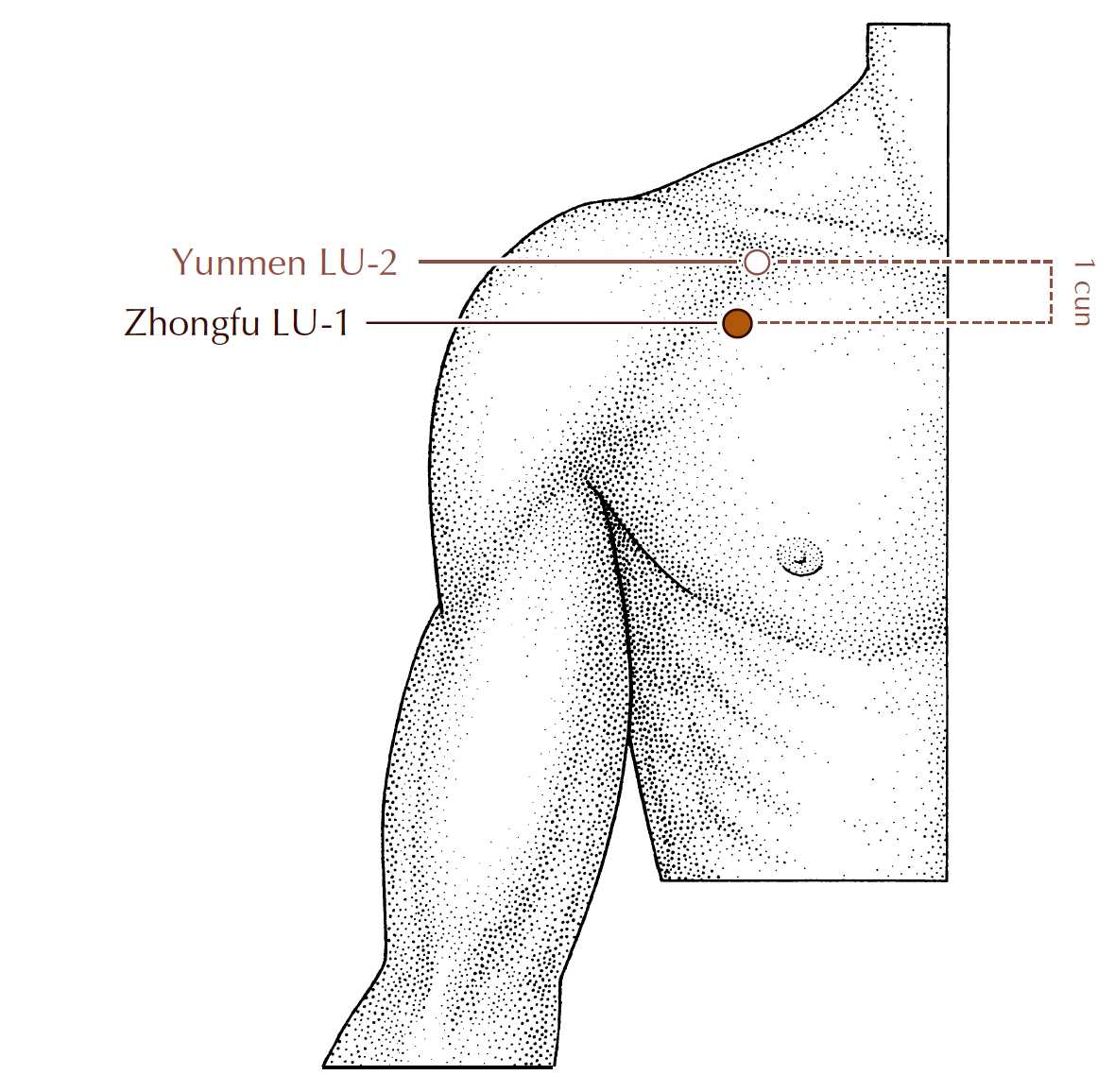
Sit comfortably with your arm relaxed and your hand resting in your lap, or find the point while lying flat.
Find your collarbone and follow it outward toward your shoulder.
Just before you reach the shoulder, let your fingers slide down off the collarbone into the depression below it.
Continue down off the collarbone about the width of your thumb, and let your fingertips sink into the bowl-like hollow space you find there, between the top ribs.
That's Lung-1. It's often a little tender, especially after long hours at a desk.
An Acupressure Practice for Lung-1
Rest your fingertips on Lung-1, on one side or both (crossing your arms into a gentle self-hug works well).
Let your fingers settle onto the surface first. You may notice some firmness or guarding there.
Instead of forcing through any resistance, wait. Let your fingertips slowly sink beneath that rigidity into the softer, more hydrated tissue underneath. Imagine the juicy, spongy quality of healthy tissue, full of moisture and life.
As you inhale, imagine moisture gathering under your fingertips, like mist collecting on a mountaintop.
As you exhale, let it flow downward, through your chest, down your arms, and into the rest of your body like water finding its way downhill.
If it feels good, add small, gentle circles. Stay for two to three minutes, letting any tenderness release at its own pace.
Once you’ve finished, pause and notice the echo of this practice. Does your breath feel more expansive? Does your chest feel softer? Do your shoulders sit differently?
Gentle pressure is all this area needs. Unlike needling, fingertip pressure works with the surface tissues and can't reach the lung itself, which makes this a safe practice to explore at home. If you have a recent shoulder or chest injury, or pressing causes sharp pain, skip the practice. Chest pain or shortness of breath that's new, severe, or worsening deserves prompt medical attention.
Continue Exploring the Lung Organ + Meridian Network
If you'd like more support for your health this season, whether it's related to the Lung meridian (e.g. frequent immune challenges, a lingering cough, dryness that won't resolve, or a heaviness you can't quite name) or something else, I'd be glad to work with you.